




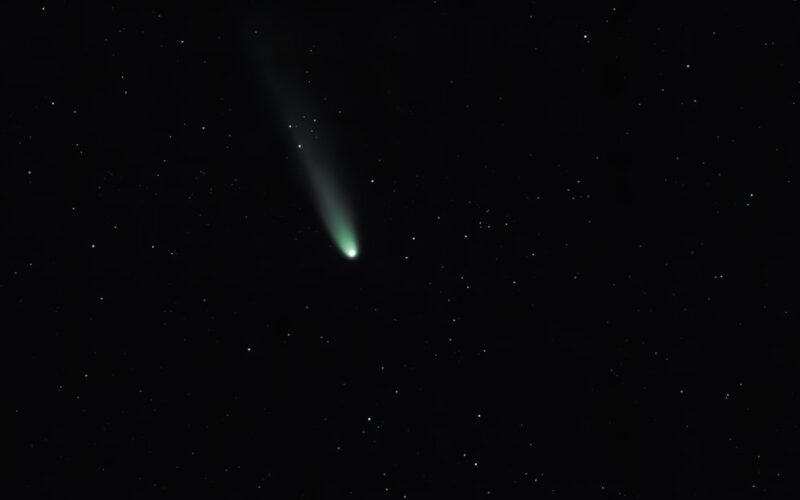
Comet fans and skywatchers are buzzing as interstellar comet 3I/ATLAS makes its closest approach to Earth in the early hours of December 19, 2025. Passing at a jaw-dropping distance of about 168 million miles (270 million kilometers)—which is almost twice the gap between our planet and the sun—this rare visitor is giving astronomers a unique opportunity to gather new data about comets from other star systems.
3I/ATLAS is only the third interstellar object ever detected by scientists, following in the tracks of ‘Oumuamua and Borisov. The comet was first spotted entering our solar system this year and has quickly become an object of global fascination. Tonight marks its closest encounter with Earth, peaking at 1 a.m. EST (6 a.m. GMT) on December 19. There’s no danger to our planet—at this distance, the only potential risk is missing out on the cosmic spectacle.
Despite all the excitement, anyone hoping for a blazing comet visible without fancy gear will be disappointed. 3I/ATLAS won’t be seen with the naked eye or even basic binoculars. Instead, you’ll need a good telescope or a trip to a local observatory to catch it yourself. Alternatively, skywatching apps can help pinpoint the comet, which currently sits in the constellation Leo, a bit away from its brightest star Regulus. Depending on your location, the comet may not be visible at the precise moment it’s closest, but it should remain visible through telescopes for several months—though it will fade as it speeds away.
X-Ray Glows, Green Halo, and a Blue Plasma Tail
Scientists have been closely tracking 3I/ATLAS and reporting fascinating features. Both ground-based telescopes and NASA’s Hubble Space Telescope have captured images showing the comet glowing green and growing brighter as it approached. The comet is trailing a spectacular blue plasma tail—photographed as recently as December 14 from June Lake, California—and is casting an X-ray glow that astonishingly stretches 250,000 miles into space. The United Nations’ International Asteroid Warning Network is keeping a close watch, not out of fear but due to scientific interest in studying a fresh sample from the interstellar beyond.
If you’re curious about tracking this interstellar traveler, you don’t need to buy extravagant tools. Free livestreams and several astronomy apps make it easy to follow its path. The closest view yet was just nabbed by a Mars orbiter, adding another feather to 3I/ATLAS’s cosmic cap. While the comet may not dazzle your naked eyes, it’s lighting up astronomers’ imaginations—and their instruments—all over the world.