



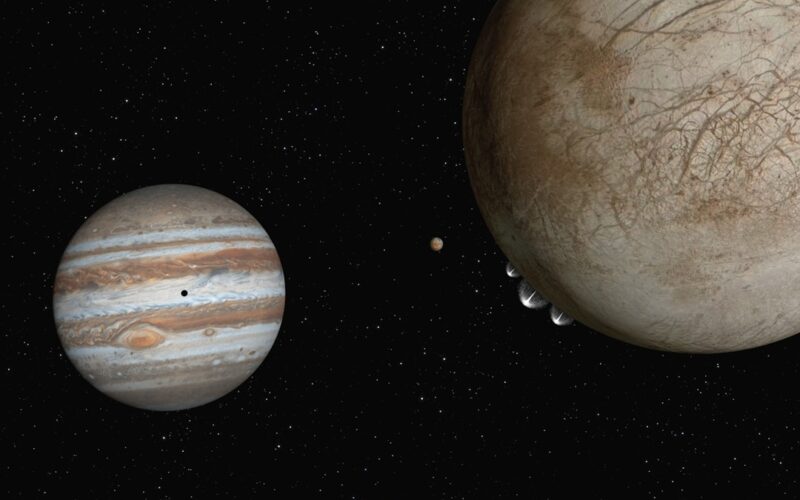
NASA just dropped some major news: scientists have detected ammonia-bearing compounds for the first time on the surface of Jupiter’s icy moon Europa. The find comes from new analysis of decades-old data, but its implications are thoroughly modern. Ammonia isn’t just another chemical—it’s a nitrogen-bearing molecule, and nitrogen is as essential to life as carbon, hydrogen, and oxygen. According to NASA’s statement on January 30, this is the first such detection at Europa, and it’s fueling conversations about whether the moon’s vast subsurface ocean could be habitable.
But there’s more. Ammonia doesn’t hang around long in space, so its presence—especially near Europa’s large fractures and pits—hints at active geological processes. “It suggests active placement of ammonia-bearing compounds… from either the moon’s subsurface ocean or its shallow subsurface,” NASA explained. For astrobiologists, that’s a tantalizing clue that Europa might have the right stuff for life under all that ice.
Ammonia’s Double Life: From Space to Sustainable Industry
While NASA’s discovery opens a new chapter in the search for life, back on Earth, ammonia is at the heart of an industrial transformation. India announced plans to start shipping green ammonia overseas as early as 2028, with Renewable Energy Secretary Santosh Kumar Sarangi revealing talks with the Netherlands at India Energy Week. This move aligns with India’s ambition to become a global hub for clean hydrogen and its derivatives—a critical step as the world seeks ways to decarbonize.
The push for cleaner ammonia isn’t just about exports. At the same event in Goa, Applied Computing and KBR, Inc. launched INSITE 3.0, a next-gen AI platform for improving ammonia plant efficiency and slashing emissions. Dan Jeavons, President of Applied Computing, highlighted the scale: “KBR’s ammonia licensing relationships represent 50% of the world’s capacity,” putting the technology in a position to make a real dent in industrial emissions.
Cutting Carbon: New Science, Real Impact
Here’s why that matters: ammonia production currently uses about two percent of the world’s total final energy and generates 1.3 percent of energy-system CO2 emissions. With climate pressure mounting, new methods—like chemical looping that uses metal oxides to transfer oxygen and avoid mixing air with fuel—are being tested. One pilot concept cut climate impacts by up to 15.85 pounds (7.2 kilograms) of CO2-equivalent per pound of ammonia produced, mainly by recycling reactants and reducing fuel use.
As researchers continue to refine these techniques and test their durability, the link between the mysteries of Europa and the realities of Earth’s energy future is clear: ammonia is central to big scientific questions, whether we’re scanning the stars or greening our industries.